Q&A WITH MILAGROS MUMENTHALER

The Swiss-Argentine filmmaker Milagros Mumenthaler has directed three features and several shorts films to date. Her work often deals with female characters, exploring questions of intimacy and interiority. Her debut, Back to Stay (2011, winner of the Golden Leopard at Locarno), revolved around three teenage sisters grieving their grandmother; her follow-up, The Idea of a Lake, charts a pregnant photographer’s investigation of her father’s disappearance; and her latest, The Currents, follows an acclaimed fashion designer whose nervous impulses overcome her life.
The Currents is now in theaters across the country.
Q. Water has become a recurring motif in your films. What is it about it that interests you as a filmmaker?
A. In truth, it’s been coincidental. My last film, The Idea of a Lake, was freely adapted from a book of poems and photographs in which water already figured as a theme. Then, with The Currents, the first image that came to my mind was of a woman in Geneva who plunges herself into freezing water; from that first moment, I knew the film would be titled The Currents.
I was interested in this idea of submarine water currents that can take you one place and then to another in a very sudden fashion. Lina [the main character], in the movie, does this. She is a living drift who lets her emotions, her gaze, and her mind take her from place to another. That’s how the film is structured, it lets itself be carried away.
Q. You write from moments and images, rather than through plot. How does that work?
A. That first image, which is very powerful, acted as the catalyst for this film. It was important because it is a gesture, a character, and water; it immediately raises a whole host of questions. It is in answering those questions, that I developed my script.
This allowed me to undertake the task of thinking about the character, and thinking from her perspective. Thinking about the film through her eyes, and how she might perceive the world while experiencing a crisis, awarded me a lot of freedom as a writer. It became like a stream of consciousness, each image mutating into the next.
Q. You’ve talked about how Virginia Woolf’s Mrs. Dalloway was an influence on this film. What is your relationship to literature as a filmmaker?
A. I read a lot throughout the entire process during which I was making this film, especially women authors writing about women characters. Literature has always fascinated me, because in cinema you don’t have first-person unless you resort to voice-over. I have always attempted to translate, or represent, that sense of intimacy in my films. This stems from my love of literature and how much I love inhabiting stories that do not belong to me.
Q. How did you go about assembling your cast, especially Isabel Aimé González Sola and Esteban Bigliardi?
A. With Isabel, we started by looking at every actress in Argentina between the ages of 35 and 40. We couldn’t find the character, so the casting director and I thought it would be interesting to look for an Argentine actress who lived abroad. It seemed to us that the Argentine actresses we were seeing had an Argentine-ness that was too evidently visible and that The Currents called for someone who wasn’t so steeped in their national identity given the main character’s altered state. The simple fact of life abroad creates a sense of difference, of distance, and it was interesting to think about a foreign body that’s dropped into Buenos Aires. That prompted us to interview Argentine actresses living in Italy, Mexico, Spain, and France. That’s how we met Isabel, who lives in France.
A lot of the time, Esteban is cast as someone who is lost in life. But Esteban, in real life, is not like that at all. He is super organized and we thought it would be interesting to explore that side of him in the film. The idea was to have him act as this organized 50-year-old who is confident about his place in life. We worked on his body language a lot to develop this idea that he was a man who thought, “This is a fruit of my work,” every time he touches something; for example, when he sits in the dining room, or when he puts on his watch in the morning.
Q. What is the last film you saw and loved?
A. Ross McElwee’s Remake.
Q. If you could choose to organize one retrospective, whose would it be?
A. David Lynch.
Q. What have you been reading lately?
A. I just finished reading Wait Until Spring, Bandini. Also, Salinger’s Franny and Zooey.
Q. What’s the first movie that ever scared you?
A. Poltergeist.
Q. What’s next for you?
A. I am working on a love story.
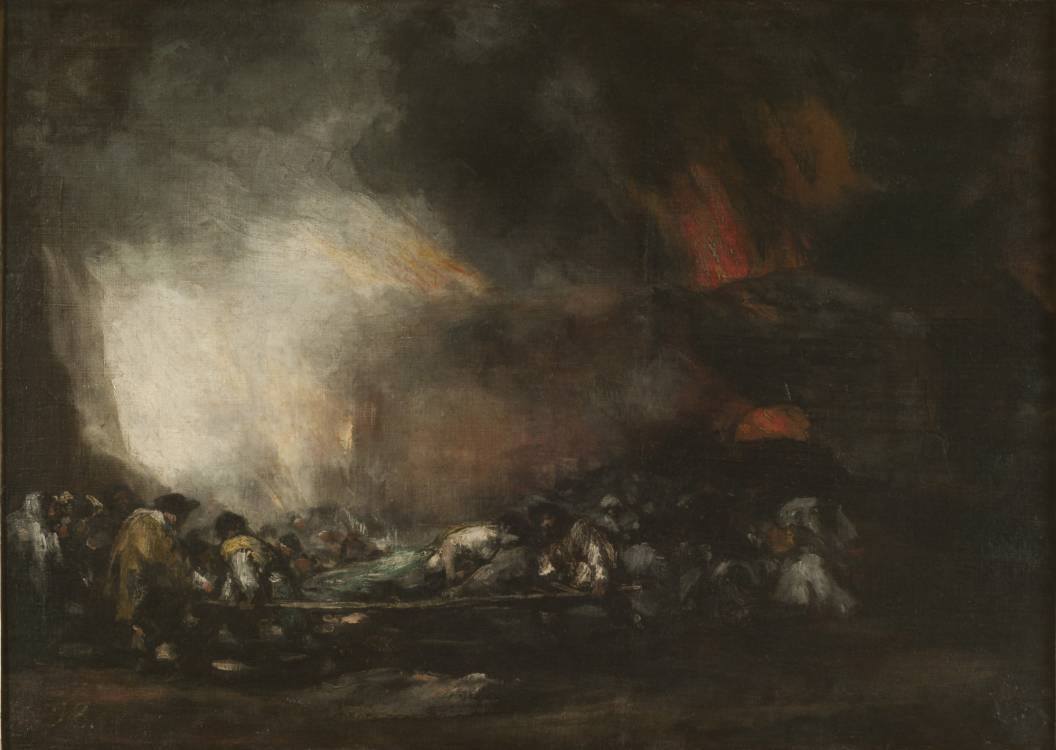
Q. What image would you like to end this interview with?
A. Fire of a Hospital, Goya.